Checklist before submitting your diploma thesis
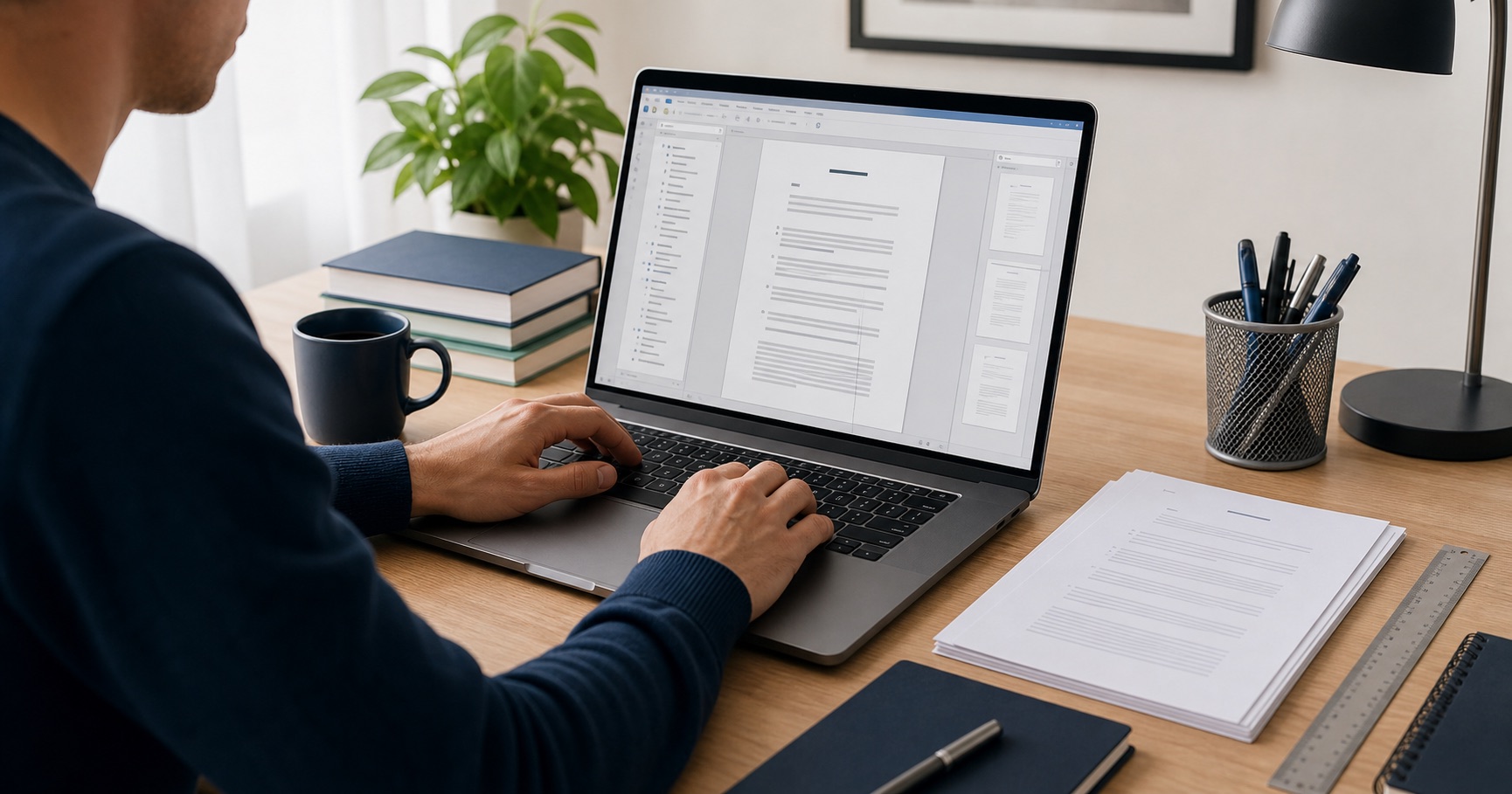
The final check of your work should not be a quick scroll through the document. It's best to split it into several separate reviews: content, structure, sources, formatting, and the final file. This makes it easier to spot errors that are not visible during normal reading.
Key information
- ✓Do a separate substantive, linguistic and technical review.
- ✓Check the consistency of the table of contents, numbering, tables, charts and appendices.
- ✓Compare each footnote with the end bibliography.
- ✓Open the final PDF file on another device before sending.
Check the structure of the work
Make sure that the work has all the required elements: title page, table of contents, introduction, chapters, conclusion, bibliography and any appendices.
Check whether the numbering of chapters and subchapters is logical and consistent with the table of contents.
Check the formatting
Before submitting your work, check the margins, font, line spacing, page numbering, headings, footnotes and captions under tables and charts.
It is worth comparing the document with the university's guidelines, as technical requirements may differ.
Check the bibliography and footnotes
The bibliography should be complete and coherent. Sources from footnotes should be included in the final bibliography.
It is worth checking whether all quotations have footnotes and whether the sources are consistent.
Read your work before submitting it
Final reading allows you to spot typos, repetitions, missing words and unclear sentences.
It's best to do this after a short break, as a fresh set of eyes helps you spot more mistakes.
Tables, charts, illustrations and attachments
Each table and illustration should have a number, title and source. Check that all objects are referenced in the text and that the numbering has not been interrupted when one of the elements was deleted. The signature cannot be left alone on a page other than the chart to which it relates.
It is worth viewing the attachments as a separate document. Remove identifying information about respondents, check references in the content, and make sure the order of attachments matches the list.
Language, repetition and final proofreading
During the first reading, focus on the sense: whether the conclusions follow from the analysis, whether the concepts are used consistently and whether the chapters achieve the purpose of the work. Only in the next pass should you correct punctuation, typos, repetitions and too long sentences.
Reading aloud helps detect unnatural rhythm and missing words. It is also useful to look for phrases that are often overused in academic texts, such as "worth noting" or "should be emphasized", and leave them only where they actually contribute something.
Final PDF and secure file sending
After exporting to PDF, check the title page, table of contents, first and last pages of each chapter, and places with large tables. Conversion can change the page division, move the signature or replace an unusual font.
Give the file a unique name that includes your name and document type. Before sending, open the attachment directly from the message or university system. This is an easy way to make sure you're uploading the correct, complete version.
Summary
The final check of your work should not involve a chaotic search for individual typos. The best effect is achieved by checking the document in stages: first the content and logic, then the language, then the footnotes and bibliography, and finally the formatting and the PDF file. A few calm passages through the checklist allow you to notice much more than one long correction made just before the deadline.
Frequently asked questions
Is it better to check your work in Word or PDF?
It is more convenient to correct content and styles in an editable file, but the final check must also be done in PDF. Only there you can see the final page division, the position of tables and any blank pages.
How much time should be allocated for the final proofreading?
For longer work, it is worth booking at least a few days. Reading after a break is more effective than correcting the document immediately after finishing writing.
What to check immediately before sending?
The name of the file, the correct version of the document, a set of attachments, the correctness of the title page and whether the file opens without errors.
Need support with your work?
Describe the topic, scope and deadline. We will review the materials, recommend the right support and prepare a clear quote.