Key information
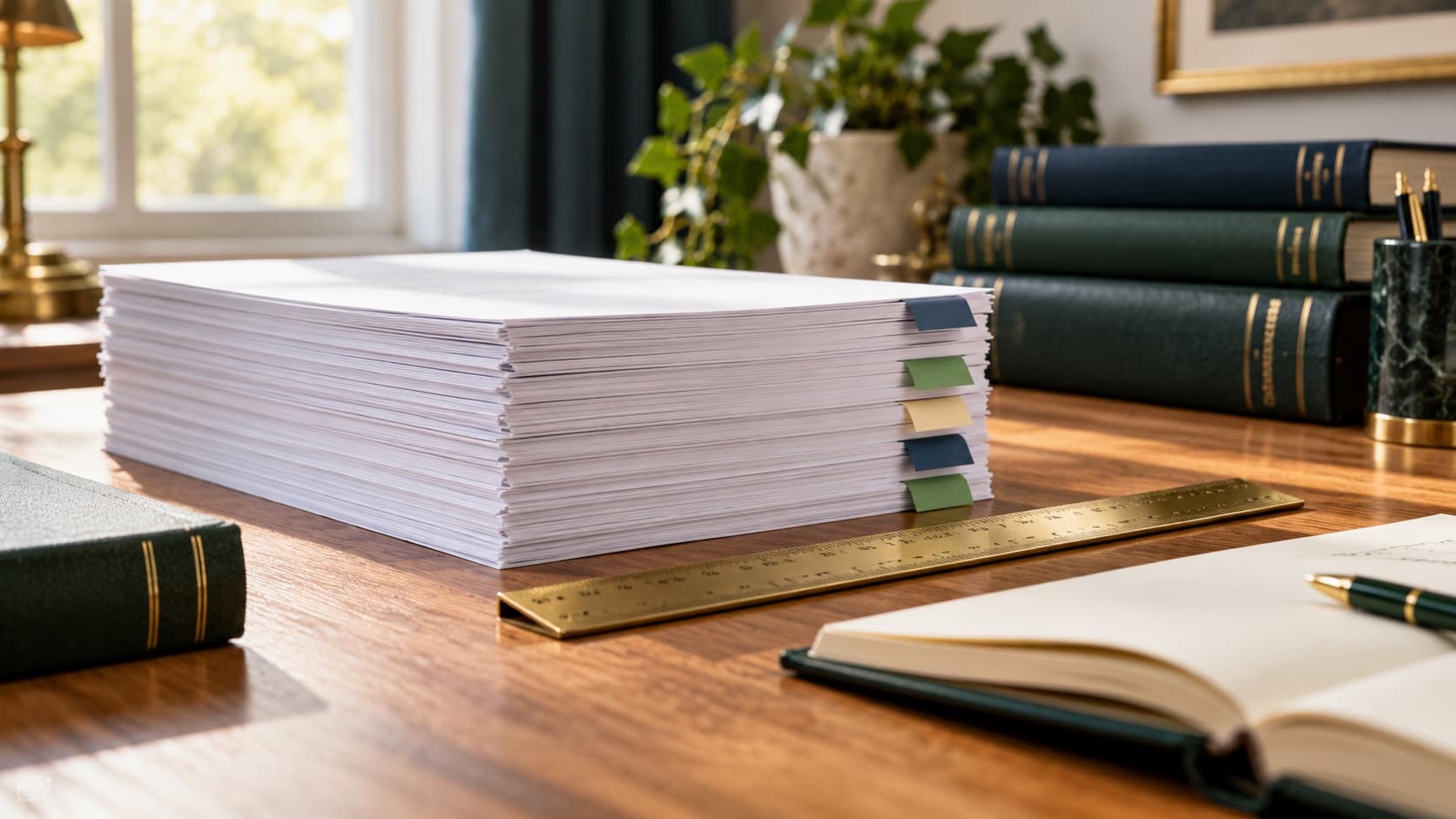
- ✓The range of 60-100 pages appears in some of the guidelines, but does not apply everywhere.
- ✓Check whether the university counts bibliography, annexes and illustrations.
- ✓Give space to method, results, and discussion before theory development.
What do sample university guidelines say?
The rules of the Faculty of Oriental Studies at the University of Warsaw include a range of 60-100 pages. The Faculty of Archeology of the University of Warsaw provided a minimum of 60 pages of standard typescript. This shows that even within one university, rules can vary between departments.
Don't transfer your limit from a friend's work or from an internet forum. The document for your field of study may also specify the number of characters, margins and the method of including additional elements.
How to divide the volume between chapters?
First, write down your purpose, questions, and analysis plan. Only on this basis should you estimate the place for theory, methodology, results and discussion. The theoretical part should provide a basis for research, and not fill most of the document with random definitions.
In an empirical study, sufficient space must be left to describe the sample, tools, procedure, results, and limitations. In design work, the emphasis may shift to assumptions, solution and its verification. Set the proportions with your supervisor, as they depend on the type of work.
What to do when text exceeds the limit?
Remove repetitions and passages that do not serve to answer your research questions. Long tables of raw data and full research instruments are usually better placed in appendices if department policy allows it.
Do not reduce the font or margins despite the instructions. A shortened, coherent argument is better than technically hiding excess text.
How can you adapt the structure to your work?
List the elements required by your department and mark those relevant to your programme and type of assignment. Compare them with your aim and the material you actually have. Only then decide the order of chapters, headings or document sections.
Give each part of the outline one job: define a concept, describe the method, present a finding or answer a research question. If two parts do exactly the same job, combine them or make their scope clearly different.
What should you check in sources and guidelines?
Use the current instructions from your own department, not a random template from another university. Check required sections, heading levels, table and figure numbering, and citation rules. An older template may contain outdated fields or a different layout.
For each planned subsection, note where its material will come from: publications, documents, data or your own analysis. If a key part has no suitable sources, narrow the topic or change the structure before writing many pages.
How can you avoid last-minute revisions?
Once you have a draft introduction, read the headings alone. Do they lead from the problem to an answer? Then compare the conclusion with the aim in the introduction and remove promises the work does not fulfil.
Update the automatic contents page, captions, cross-references and numbering. Open the exported PDF because a table or page break may move outside the editor. Keep an editable copy before the final export.
A practical check before sending the file
Make a copy and read the document in the reader's order: title page, contents, introduction, main chapters, conclusion, references and appendices. Mark headings that promise something different from the paragraph below them. This catches gaps more effectively than correcting isolated sentences in random order.
Check automatic elements in Word too: heading styles, table and figure captions, cross-references and page numbers. If your department provides a template, compare both the DOCX and final PDF with it. The exported file may look different from the editing view.
Summary
A good volume plan starts with research questions, method and supervisor requirements. Merely achieving a page count is not a substitute for argumentation or analysis of the results.
Frequently asked questions
Does a master's thesis have to be 100 pages long?
NO. Examples of regulations specify 60-100 pages, others specify a different range or only the minimum. The answer for your work comes from the current rules of the field.
Is 60 pages not enough?
Not necessarily. If the university allows for this volume, and the text achieves the goal and contains the required analysis, the number itself is not a problem.
Do appendices increase the number of pages of a thesis?
They may add pages to a file, but are not always included in the required text. Check the definition of volume in the department's guidelines.
Need support with your work?
Describe the topic, scope and deadline. We will review the materials, recommend the right support and prepare a clear quote.