Key information
- ✓First, check to see if the university is making its own APA modifications.
- ✓Please include the author and year in the citation, and also the page in the citation.
- ✓Save DOI as the active address https://doi.org/.
- ✓Perform a two-way citation and bibliography check.
In-text citation: author and year
When paraphrasing, the author's name and year of publication are given. The data may appear in brackets or in a sentence. A literal quotation additionally requires a page number or other location indication.
For multiple authors, abbreviation rules apply depending on the number of authors. However, the entry in the bibliography should not be abbreviated in the same way as citations in the text.
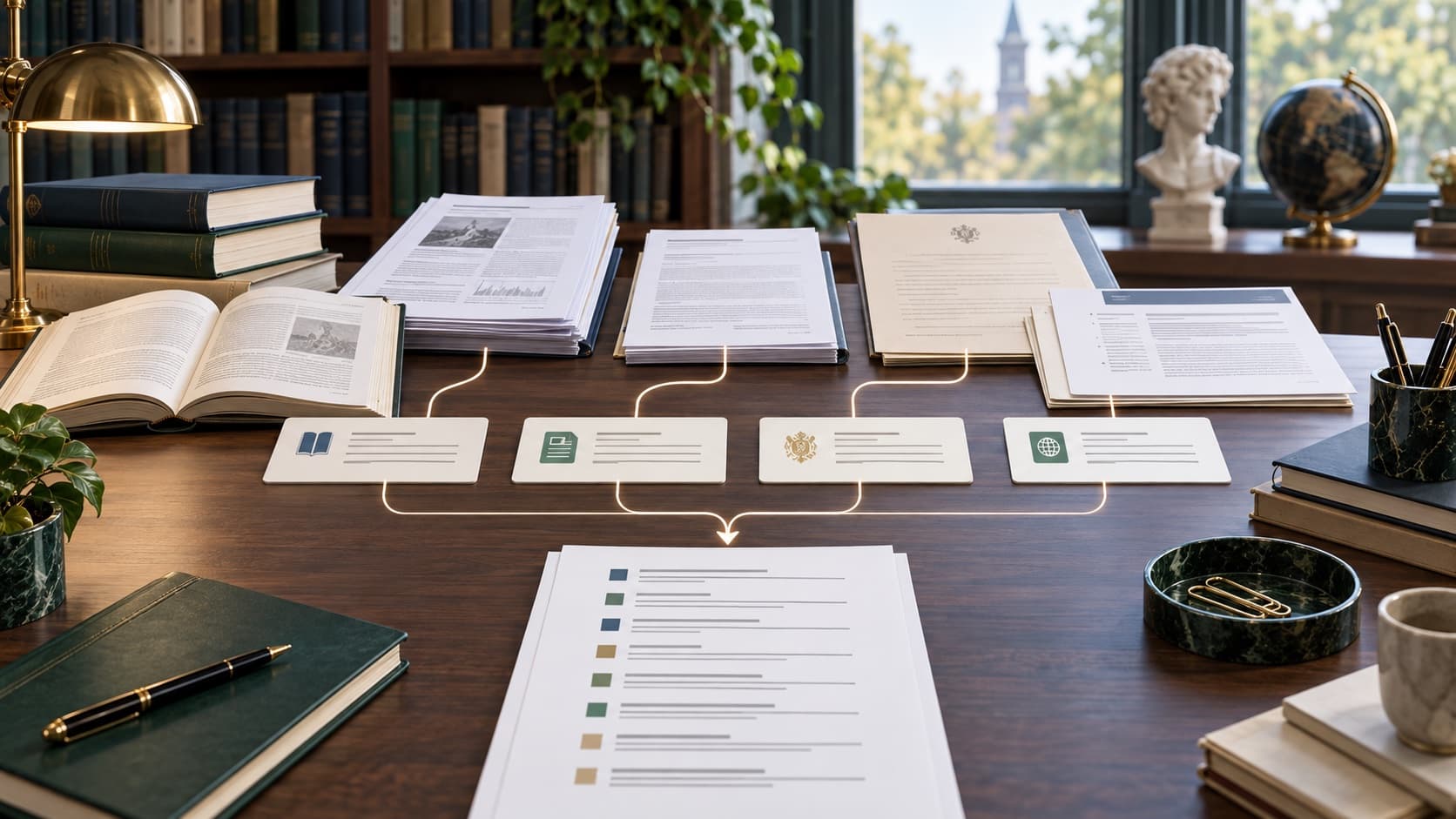
Book, chapter and scientific article
The book description includes the author, year, title in italics, and publisher. For a chapter in a collective work, you must also provide the editors, the title of the entire book and the range of pages.
The article requires the text title, journal name, volume, number, pages and DOI, if assigned. Capitalization and italics have specific functions and should be used consistently.
Internet sources and DOI
Not every material available online is a regular website. An article found in the database is still described as an article, and an institution's report is still described as a report. The format is selected according to the type of document, not where it was downloaded.
Save DOI as full address. Remove unnecessary tracking parameters from links and check whether the address leads to the correct document.
Checking the bibliography before submission
Sort items alphabetically, check indentation, punctuation and completeness of data. Then search for each name in the bibliography in the text and each citation in the list of sources.
The bibliography manager can speed up your work, but it does not relieve you of metadata control. The automatically downloaded record often contains incorrect capitalization, missing issue number or an incomplete list of authors.
First establish which document you are describing
The most common APA 7 reference-list problem begins before you apply italics: the author chooses the wrong source type. A PDF may contain an article, report, book or presentation. The file extension alone does not determine the reference format. Open the title page and publisher's record, then note the author, date, title and publication information. For a chapter, check whether its author is the same person as the volume's editor. Citing the whole book instead of the chapter you used can obscure authorship of a particular concept. Also record the pages you used in your working notes. A record prepared this way is easier to correct than a description assembled from random elements of different formats. Official APA examples help you choose the document category; your university's local instructions establish whether the full standard or a particular adaptation applies.
Plan the boundaries of a paraphrase within a paragraph
A source citation should show which claim comes from the cited author. If an entire paragraph summarises one publication, readers must be able to recognise this connection beyond the first sentence. When you move to your own interpretation or another source, mark the change through the structure of the text. You can write a teaching example without inventing a publication: '[Author] ([year]) distinguishes three categories. This thesis adopts the second category as a reference point for analysis.' The first sentence reports the source; the second describes the thesis author's decision. In the final text, replace the placeholders with actual details and check that the meaning is accurate. Adding one parenthetical citation at the end of a page full of borrowed information is insufficient. At the same time, avoid mechanically repeating an identical citation after every short sentence if the extent of source use remains unambiguous.
Choose a locator suited to the source type
A direct quotation needs a locator that allows the passage to be found. In a book this will usually be a page number, but online material may have no pagination. In that case, check whether you can identify a paragraph, section or another stable part of the document. Do not enter a page number visible only in the browser window if it does not correspond to the publication's numbering. Also consider the quotation's length: APA distinguishes a short quotation from a block quotation containing at least 40 words. Before final formatting, compare your presentation with an official example and faculty instructions. Above all, check whether quoting verbatim is necessary. If you are analysing the meaning of a concept, a carefully developed paraphrase may be clearer; if you are analysing the exact wording of a definition, a quotation has a clear justification. Both approaches still require a source.
Be transparent about using a secondary source
If you know a concept only through its discussion in another publication, try to find the original. This lets you check context that may have been shortened in the summary. If the original remains unavailable, identify the secondary source in accordance with APA and the language version you have adopted. Readers should know which text you actually read. Do not create the impression in your reference list that you independently read a document you could not access. In a teaching example, your note might contain two separate fields: 'author of the concept discussed' and 'publication actually used'. This distinction prevents mistakes during later editing. Using a discussion of a source does not remove the need for caution: do not attribute claims to the original author that the available text does not present. Use secondary sources deliberately, particularly for key definitions and the thesis's most important arguments.
Check your reference list in three rounds
The first round concerns complete information: authors, dates, titles and details that make the publication findable. The second checks correspondence between citations and the list, including surname variants, different publication years and entries with similar titles. The third covers presentation: order, italics, indentation and punctuation. Separating these tasks helps you notice errors that escape one quick reading. For every unclear entry, return to the document or official record instead of copying a reference from someone else's thesis. Do not supply a missing issue number based on a similar article. If a reference manager produces the same error in several places, correct the source record and regenerate the reference. A manual correction to one parenthesis can disappear during the next refresh, so it is worth eliminating the cause of the inconsistency.
Summary
Correct APA 7 is not about remembering all the exceptions, but about consistent data collection and two-way control: every citation leads to a bibliography, and every bibliographic item was used in the text. Before turning in, check your transcript against the official guide and your university's requirements.
Frequently asked questions
Does APA 7 use footnotes for sources?
Basic references to sources are placed in the text in the author-year system. Footnotes are mainly for additional explanation if needed.
Do I need to provide the date of access to the website?
Typically not, unless the content is variable and unarchived. It is always worth checking the detailed university guidelines.
Can I have the APA 7 bibliography checked?
Yes. You can upload text, bibliography and university instructions. We will check the scope of inconsistencies and prepare an estimate for organizing citations and descriptions.
Is an APA 7 generator enough to prepare correct references?
A generator helps assemble a reference, but works with the supplied data and identified document type. If the chapter author is missing or the year is wrong, correct presentation will not fix the record's content. Check the result against the publication and an official example. Pay particular attention to institutional material, chapters in edited volumes and records imported from websites with incomplete metadata.
Need support with your work?
Describe the topic, scope and deadline. We will review the materials, recommend the right support and prepare a clear quote.